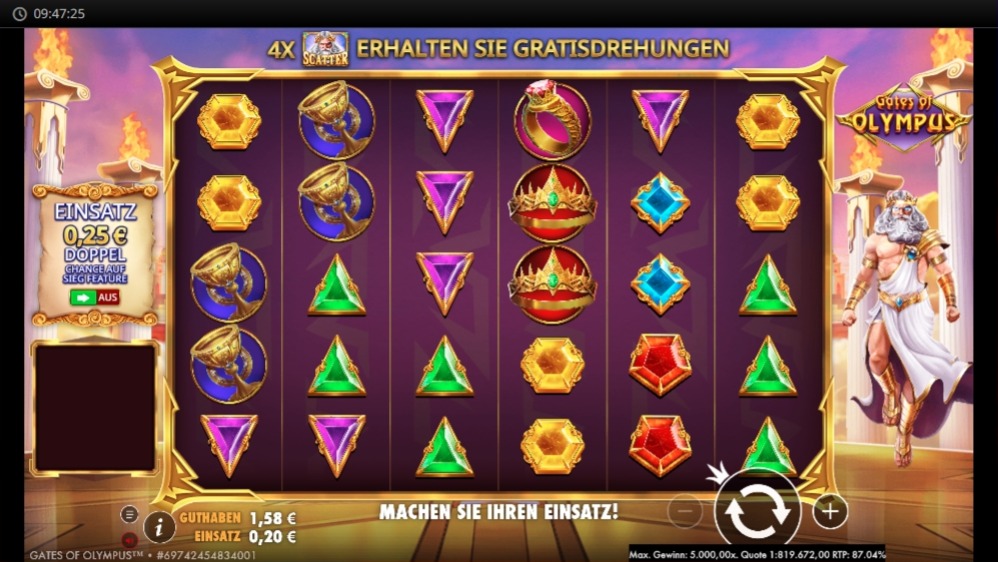
Anyone comparing new Reel Kingdom slots against the studio’s line-pay back catalogue will notice something odd in the published figures. Cluster-pay and cascading titles routinely advertise hit rates of 40% or higher, while a 10-line Big Bass release sits nearer 20 to 25%. The gap looks like generosity. It is mostly bookkeeping. A cascade pays on every tumble in a chain, and each tumble is logged as its own win event, so one paid spin can register three, four or five “wins” before the reels settle. Divide those events by paid spins and the headline number climbs without a single extra pound going back to the player.
That distinction matters more in 2026 than it did when tumbling reels were a novelty. Reel Kingdom distributes its catalog via Pragmatic Play, and the pipeline keeps widening: Big Bass Vegas 1000 landed on 14 Sep 2026 with a default RTP of 96.53% and a 15,000x max win, while Bear Crazy pushes the reel architecture out to 20 paylines. Reviewers quote hit frequency from the help screen without saying whether the denominator is paid spins or individual cascade steps. Players then compare a cluster title’s inflated percentage with a line-pay game’s per-spin figure and draw the wrong conclusion about which machine pays more often. The return to player percentage is identical in kind across both; only the reporting unit has changed.
This deep dive treats the problem as an arithmetic one. It walks through how cascade steps get counted, why hit rate inflates while RTP stays fixed, and how to read Reel Kingdom slot reviews with the per-spin versus per-cascade question in hand. It then sets out a logging method for Reel Kingdom demos that normalises hit rate to paid spins, so a cluster-pay release can be compared fairly with a 10-line equivalent. Volatility ratings, feature buy pricing and maximum win exposure all get the same treatment. Read the help screen before the marketing copy, count spins rather than events, and the numbers start meaning what they appear to mean.
How Cascading Reels and Cluster Pays Reshape the Win Event
A cascade slot does not end when the reels stop. It ends when a sequence of tumbles runs dry. That distinction is the root of almost every inflated hit-rate figure you will see quoted for cluster-pay titles, so it is worth pinning down before comparing anything.
The mechanics are straightforward. A paid spin resolves, winning symbols are removed, and surviving symbols fall to fill the gaps. New symbols drop in from above. If that new arrangement produces another win, the process repeats. Each repetition is a tumble, and each tumble is a discrete win event in the game’s internal accounting.
Two Evaluation Models, One Shared Consequence
Cluster-pay games evaluate wins by adjacency rather than by paylines. A minimum of typically five connected symbols, horizontally or vertically, forms a cluster and pays according to the paytable. There is no left-to-right requirement and no fixed payline structure, which means a single board can contain several qualifying clusters at once. Line-pay games, by contrast, resolve each of their fixed lines independently.
Cascading reels can sit on top of either model. A 10-line game with tumbles removes winning symbols and re-evaluates the same ten lines. A cluster game removes the cluster and re-evaluates the whole board for new adjacencies. The evaluation logic differs; the counting logic does not. In both cases, the software logs the initial spin result plus every subsequent tumble as separate outcomes.
- Paid spin: one wager, one debit from balance.
- Base resolution: the first evaluation of the reel array.
- Tumble: any cascade step that follows a removal, each independently evaluated.
- Win event: any evaluation that returns a payout above zero.
This is why a game can report a hit frequency north of 40 per cent while still feeling streaky. The published figure often counts win events, not winning paid spins. A single spin that tumbles six times and pays on four of those steps contributes four to the numerator but only one to the denominator if the metric is per-event. Divide by paid spins instead and the number falls sharply, sometimes by half.
The trade-off is not dishonest, but it is asymmetric. Cascade titles look denser in win frequency than line-pay equivalents from the same studio, and reviewers rarely state which denominator they used. Reel Kingdom’s line-pay output, including the 10-line mechanics that Big Bass Football Bonanza maintains, resolves once per spin unless a modifier is triggered, so its hit rate is closer to a per-spin measure by default.
Practical consequence: before you trust any hit-rate claim, check the help screen and the developer specifications for whether wins are counted per spin or per cascade. If the documentation is silent, assume per-event and normalise downward. The slot mathematical model has not changed; only the reporting granularity has.
Why Hit Rate Inflates: Counting Cascade Steps as Separate Wins
Take a cluster-pay title that pays on 1 in 3 paid spins and tumbles twice on average when it does pay. Log the tumbles as separate wins and the screen reports a hit rate of roughly 67%. Nothing about the maths changed. The denominator shrank relative to the numerator because every cascade step got its own tick in the win column.
Work the arithmetic on a 1,000-spin sample. Suppose 330 spins pay at least once, and those 330 spins produce 670 winning cascade events in total, because the average paying spin tumbles through two or three steps. Per paid spin the hit rate is 33%. Per cascade event it reads 67%. The gap is not a rounding error; it is a definitional shift, and it is the single biggest reason cluster-pay titles look busier than line-pay games with identical maths.
| Metric |
Line-pay game (10 lines) |
Cluster-pay game, per paid spin |
Cluster-pay game, per cascade |
| Paid spins sampled |
1,000 |
1,000 |
1,000 |
| Spins that pay |
280 |
330 |
330 |
| Winning events logged |
280 |
330 |
670 |
| Reported hit rate |
28% |
33% |
67% |
Note what did not move: the return to player percentage. RTP is total return divided by total stake, and a cascade chain is simply one payout arriving in instalments. Whether the game credits 2.00 in one step or 0.80, 0.70 and 0.50 across three tumbles, the sum against the stake is unchanged. Hit frequency is a count of events, not a measure of money, so it is the statistic that bends.
The comparison trap is sharpest against Reel Kingdom’s line-pay output. A 10-line title such as Big Bass Football Bonanza evaluates fixed paylines once per spin, so one paid spin equals one win event at most. Put its published hit frequency beside a cluster-pay game’s per-cascade figure and you are comparing apples to a fruit salad. Normalise first: divide winning cascade events by paid spins, and only then set the two numbers side by side.
Two further checks stop the inflation from misleading you. Confirm the source states its denominator, because most review sites quote whichever figure is higher without saying so. Then sanity-check against volatility: a high variance slot can carry a per-cascade hit rate above 60% and still feel sparse, because the tumbles are small and the big multipliers sit deep in the tail. Hit rate tells you how often the screen lights up, not how much it pays when it does.
Practical rule: treat any hit-rate figure above 50% on a cluster-pay game as a per-cascade number until proven otherwise, and halve it as a rough per-spin estimate before comparing it with a Reel Kingdom line-pay equivalent.
Reading Reel Kingdom Slot Reviews Without Being Misled
Reel Kingdom slot reviews tend to quote a handful of numbers in the same breath: RTP, volatility, maximum win, hit rate. The first three are usually comparable across titles. The fourth is not, and it is the one most often presented without a footnote. Treat every hit-rate figure as suspect until you know its denominator.
Work through this checklist before you trust a review’s statistics.
- Check the denominator on hit rate. A figure like “1 in 3 spins wins” is per paid spin. A figure like “45% hit rate” on a cluster-pay title is often per cascade event. The same game can honestly report both. Only the per-spin number is comparable with a 10-line release such as Big Bass Football Bonanza, which maintains 10-line mechanics and pays on lines, not clusters.
- Confirm RTP is the default, not a range. Big Bass Vegas 1000 has a default RTP of 96.53%, but licensed operators can run lower configurations. A review that quotes the top figure without saying which version is live in your market is incomplete. Cross-check the help screen inside the game itself.
- Separate volatility from maximum win. A max win of 15,000x on Big Bass Vegas 1000 tells you about the tail of the distribution, not the typical session. Volatility rating tells you how often that tail is approached. A high variance slot with a 15,000x cap and a medium volatility slot with the same cap behave very differently over 500 spins.
- Look for the feature buy price. Reviews regularly omit it, and some games genuinely lack one. Club Mamaia, for example, lacks a published feature buy price, which changes how you value the bonus round. If a review discusses the free spins but not the buy cost or the ante bet feature, it has skipped a cost line.
- Note the payline structure and reel architecture. Bear Crazy expands reel architecture to 20 paylines. That is a mechanical fact a review should state plainly, because it drives both hit frequency and the shape of the paytable.
- Check whether demos match the review build. Reel Kingdom demos are usually the default RTP version. Your live game may not be.
What reviewers typically leave out: the RTP configuration tested, whether hit rate counts tumbles, the number of spins behind any simulation, and the source of the volatility rating. Golden Retriever has a volatility rating of High, but a rating is a label, not a measurement. Unless the reviewer cites developer specifications or a slot audit, treat the label as marketing shorthand.
One structural note matters here. Reel Kingdom distributes its catalog via Pragmatic Play, so the specification sheets reviewers work from are Pragmatic Play documents. Where a review contradicts the help screen, the help screen wins. Verification takes two minutes and settles most disputes.
Read reviews for mechanics, paytable detail and feature descriptions. Read the help screen for numbers.
Reel Kingdom RTP, Hit Frequency and House Edge Explained
Start with the definitions, because the three numbers get mixed up constantly in Reel Kingdom slot reviews.
- Return to player percentage: total returned to players divided by total wagered, measured over a very large sample. Reel Kingdom RTP on a title such as Big Bass Vegas 1000 sits at 96.53% at default settings, which implies a house edge of 3.47p per GBP 1 staked across the model.
- Hit frequency: the share of outcomes that return something above zero. This is the figure cascade counting distorts.
- Variance (slot volatility): the spread of results around the RTP. A high variance slot pays rarely and heavily; a medium volatility slot sits closer to the average.
The key point: RTP is calculated on money, not on events. Every cascade tumble that pays is a real credit to the balance, and the slot mathematical model already accounts for it in the return figure. Counting one spin as three wins does not create money. It only changes the denominator of the hit-rate fraction, and that is where the distortion lives.
Run the arithmetic on a simple case. Take 1,000 paid spins. Suppose 280 of them produce at least one paying tumble, and cascades add 220 further paying steps. Per paid spin, hit frequency is 28%. Per paying event, it reads 500 divided by 1,220, or roughly 41%. Same money, same RTP, two very different impressions of how often you win. A reviewer quoting the second number without a label is not lying, but the figure is not comparable with a 10-line Reel Kingdom game where each paid spin yields at most one win event.
House edge behaves the same way as RTP. It is fixed by the paytable, the reel strips and the feature weighting, not by how outcomes are tallied. A cascade title with 96.53% RTP and a line-pay title with 96.53% RTP have identical expected loss per pound staked. What differs is the shape of the ride: cluster-pay and cascade games often land in the medium to high volatility band, so the losing runs are longer and the winning spins are chunkier. Perceived win density drops even as the reported hit rate climbs.
Two practical checks. First, open the help screen verification panel and note the RTP figure and any stated hit frequency, then ask whether the hit frequency is defined per spin or per win event. Many developer specifications are silent on this, which is itself informative. Second, treat maximum win exposure as a separate axis again: a 15,000x cap tells you the tail of the distribution, not the frequency of wins. Confusing the three numbers is the most common error in reading Reel Kingdom slots 2026 releases, and it costs players real money when they pick a game on headline stats alone.
Testing the Theory: Using Reel Kingdom Demos to Normalise Hit Rate
Reel Kingdom demos give you a free play environment with the same mathematical model as the paid game, so you can log outcomes yourself instead of trusting a headline figure. The method below takes 30 to 45 minutes per title and produces a hit rate you can defend.
- Step 1. Load the demo from a licensed operator or the developer’s own preview build. Confirm the paytable and help screen verification match the live version, including the RTP shown for the jurisdiction you play in.
- Step 2. Fix your sample before you spin. 500 paid spins is the practical floor; 1,000 is better for a high variance slot. Record the stake and keep it constant so feature buy or ante bet feature costs do not muddy the count.
- Step 3. Use two counters, not one. Counter A tracks paid spins. Counter B tracks every tumble or cluster evaluation that credits a payout, including chains that follow a single paid spin. Note each cascade step separately in a simple table.
- Step 4. Count only credit events. A tumble that clears symbols but pays nothing is not a win. A cluster that pays 0.2x is a win. Write the rule down and apply it without exceptions.
- Step 5. Calculate both figures. Raw hit rate equals Counter B divided by Counter A. Normalised hit rate equals the number of paid spins that produced at least one payout divided by Counter A.
- Step 6. Repeat against a line-pay control. Run the same 500 spins on a 10-line Reel Kingdom title such as Big Bass Football Bonanza, which maintains 10-line mechanics, and log paid spins versus winning spins. Line-pay games have no cascade steps, so its raw and normalised figures should sit close together.
- Step 7. Compare like with like. Put normalised cluster-pay hit rate beside the line-pay control, then check volatility ratings and maximum win exposure before drawing any conclusion about which game feels denser.
A worked example makes the distortion obvious. Suppose 500 paid spins on a cluster-pay demo produce 610 paying tumble events across 190 winning spins. Raw hit rate is 122 per cent, which is meaningless as a comparison. Normalised hit rate is 38 per cent. The line-pay control might show 500 paid spins and 132 winning spins, a hit rate of 26.4 per cent. On paper the cluster title looks far denser; normalised, the gap is 11.6 percentage points, and the cluster game may simply be paying smaller amounts more often within each chain.
Log three more columns alongside your counters: average win per paid spin, largest single cascade chain, and whether any payout exceeded 100x. These give you a rough read on slot volatility that published figures rarely capture. If the demo includes a feature buy, price it separately and exclude those purchases from the hit-rate sample.
One caveat on sample size. A medium volatility slot settles into a stable pattern within 500 spins. A high variance slot such as Golden Retriever, rated High, can swing wildly across that sample, so treat any normalised figure from a short run as indicative only. The number is a tool for fair comparison, not a prediction of your next session.
What to Expect from New Reel Kingdom Slots in 2026
Release cadence and the 2026 slate
Track the release log rather than the marketing banner. Reel Kingdom distributes its catalog via Pragmatic Play, and that pipeline has been steady rather than spectacular: a handful of Big Bass sequels a year plus a smaller number of experiments. Big Bass Vegas 1000 was released on 14 Sep 2026 with a default RTP of 96.53% and a max win of 15,000x, which tells you the flagship line is still built on line-pay mechanics and a single bonus trigger, not on tumbles.
The pattern around it matters more than any single title. Big Bass Football Bonanza maintains 10-line mechanics. Bear Crazy expands reel architecture to 20 paylines. Neither adopts cluster evaluation. For 2026 that is the headline finding: Reel Kingdom is widening the reels and raising payline counts, not rebuilding the win event around cascades. Players scanning new Reel Kingdom slots for tumble mechanics will find few candidates, and those that appear tend to sit outside the Big Bass line.
Use this as a checklist when a 2026 release lands:
- Read the help screen verification of paylines and evaluation rules before trusting a review headline.
- Check whether the developer specifications list a cascade or tumble mechanic at all.
- Confirm the default RTP and whether an ante bet feature or feature buy changes it.
- Log the volatility rating (Golden Retriever carries High) against the stated max win exposure.
Comparing headline statistics across the 2026 catalog
Cascade and cluster mechanics inflate hit rate by counting each tumble as a separate win event. That distortion only bites when you compare across mechanic types. Within Reel Kingdom’s line-pay catalog, per-spin and per-cascade hit frequency are the same number, so a 2026 Big Bass release can be compared directly with a 2019 one on published figures.
The risk sits at the edges of the catalog. Where a 2026 title does adopt cluster pays, its advertised hit rate will look denser than a 10-line or 20-line sibling at identical RTP. Normalise before drawing conclusions: divide cascade events by paid spins from a demo session, then set the result beside the line-pay figure. RTP itself is unaffected by the counting method, so a 96.53% return stays 96.53% whichever way wins are tallied. Volatility, not hit rate, is the honest guide to how a slot feels.
Two practical notes for the year. First, treat any review that quotes hit frequency without saying whether it is per spin or per cascade as incomplete; the slot mathematical model documentation usually settles it. Second, watch for feature buy and ante bet pricing in territories where a licensed operator publishes them. Club Mamaia lacks published feature buy price data, and gaps like that are common in 2026 releases, so verify on the help screen before staking. A site operating as an informational resource can flag the omission; only the operator’s own documentation closes it.
The working assumption for the year: expect more paylines, familiar volatility bands and few genuine cascade conversions. Compare like with like, and the headline statistics stop misleading you.
The practical next step is to build a small comparison sheet before you commit real money to any cluster-pay title. Pick three or four games you are considering, note the published return to player percentage, the volatility rating and the maximum win exposure from the paytable or help screen, then run each one in free play demo for at least 200 paid spins. Log two columns only: paid spins and paid spins that returned anything at all. Ignore every tumble after the first. That single ratio is your normalised hit rate, and it is the number you can honestly set beside a 10-line release such as Big Bass Football Bonanza or a 20-payline layout like Bear Crazy, where each paid spin produces exactly one win event by design. If a reviewer quotes a hit frequency above roughly 50 percent on a cascading slot, assume cascade steps are being counted and halve your expectations accordingly.
Two further checks are worth the five minutes they cost. First, open the help screen and confirm the developer specifications match the review you are reading, because RTP variants and feature buy pricing are frequently misquoted, and a title like Club Mamaia can circulate in review round-ups with no published feature buy price at all. Second, treat the ante bet feature as a cost decision rather than a convenience: it raises stake by a fixed percentage to lift trigger frequency, which changes your bankroll maths without changing the underlying slot mathematical model. For a benchmark, Big Bass Vegas 1000 carries a default RTP of 96.53 percent and a 15,000x maximum win, and its release date of 14 Sep 2026 makes it a useful reference point when you are weighing new Reel Kingdom slots against older catalogue entries. Keep the sheet updated as you test, compare like with like, and let your own logged spins rather than headline statistics decide where the next deposit goes. Treat any slot audit or review that will not state whether its figures are per spin or per cascade as unverified until you have checked it yourself.